
How AI powered chatbots are rewriting B2B social media marketing
The complete guide for B2B marketers ready to stop guessing and start converting customer engagement into lead generation strategies that actually work.
Sufi Inam Ul Hassan
AI Engineer9 minute read
The complete guide for B2B marketers ready to stop guessing and start converting.
Introduction, the 7:14 PM problem
Here is a situation that plays out thousands of times a day. A senior procurement manager at a mid size manufacturing company sees your LinkedIn post. She is curious. She clicks to your website. She has three questions about your enterprise pricing and implementation timeline. It is 7:14 PM on a Thursday. Your sales team is offline.
She waits. No response. She moves on. You never knew she was there.
Now replay that scenario with an AI powered chatbot deployed across your social media touchpoints. She asks. It answers instantly, intelligently, and in context. It qualifies her, books a discovery call for Monday, and tags her as a high intent enterprise lead in your CRM. All before she finishes her coffee.
This is not a future state vision. This is happening right now in B2B companies across tech, logistics, SaaS, manufacturing, and professional services. And the B2B marketers who are deploying AI powered chatbots in their social media marketing campaigns are outperforming competitors by metrics that would have seemed impossible five years ago.
Let us break down exactly how, with a step by step framework and an illustrative scenario that shows what the numbers can look like.
Step 1, why traditional B2B social media marketing is breaking down
Before we talk about the AI solution, it is worth being honest about the problem. B2B social media marketing has a fundamental tension built into it that most teams never resolve.
B2B buying cycles are long. Decisions involve multiple stakeholders. The content that attracts attention on social media is rarely the content that closes deals. And the moment a prospect moves from casual engagement to genuine interest, the traditional response is to hand them a form, a brochure download, or a promise that someone will follow up.
That gap between social engagement and sales conversation is where most B2B leads die. The average response time for B2B companies to an inbound lead inquiry is 47 hours. Studies consistently show that response within the first 5 minutes increases lead conversion by 400%. Most B2B social media strategies have no mechanism to close that gap.
The core problem
B2B social media generates awareness efficiently. It converts leads inefficiently. AI chatbots are specifically designed to solve the conversion half of that equation by providing immediate, intelligent, personalized responses at exactly the moment a prospect demonstrates intent.
Step 2, what AI powered chatbots actually do in a B2B social media context
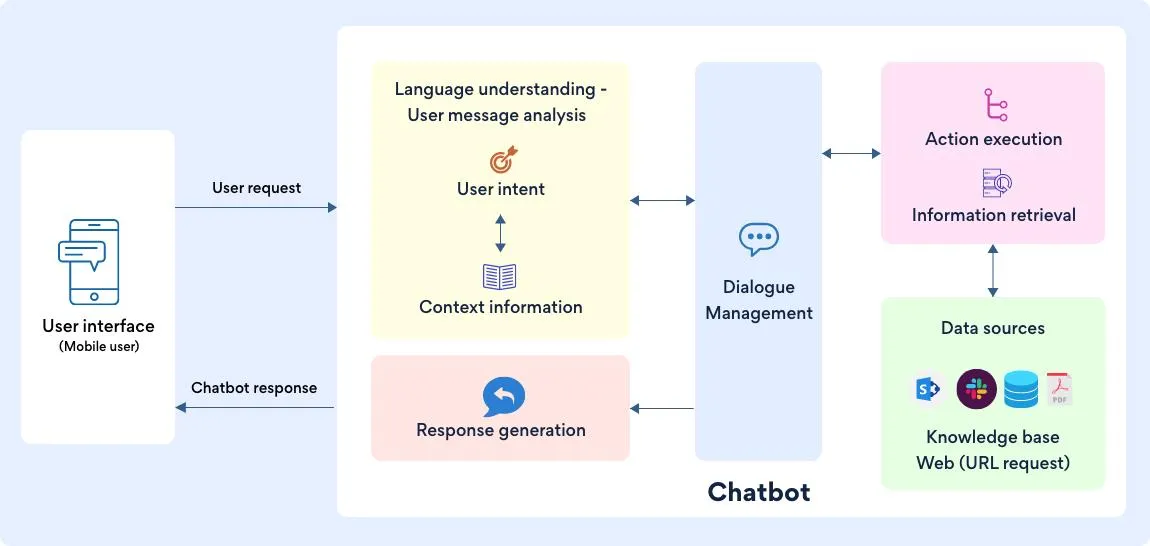
The term chatbot carries baggage from years of clunky rule based systems that frustrated users more than they helped them. Modern AI powered chatbots for B2B social media are categorically different. Here is what they actually do:
| Capability | How it works | B2B impact |
|---|---|---|
| Intent detection | Reads conversation signals to identify high value versus browsing prospects in real time. | Prioritizes sales team follow up on the leads most likely to convert. |
| Qualification automation | Asks BANT style questions (Budget, Authority, Need, Timeline) conversationally. | Delivers prequalified leads, cutting average sales cycle length by 20 to 35%. |
| Personalized content | Serves relevant case studies and whitepapers based on industry and pain points. | Increases content engagement rates by 3x versus generic link posts. |
| Meeting booking | Integrates with calendar tools to schedule discovery calls directly. | Eliminates the email back and forth that kills momentum. |
| CRM enrichment | Pushes transcripts, lead scores, and contact data directly to Salesforce or HubSpot. | Creates a seamless handoff that gives sales full context before the first call. |
Step 3, the key social media platforms where AI chatbots drive B2B results
Not all social platforms deliver equal value for B2B AI chatbot deployment. Here is where the real ROI lives:
LinkedIn, the B2B goldmine
LinkedIn is where B2B social media marketing generates the highest quality leads and where AI powered chatbots create the most dramatic efficiency gains. Automated LinkedIn messaging, comment engagement bots, and Sponsored Message chatbot integrations allow B2B companies to engage with C suite prospects, respond to post comments at scale, and initiate personalized conversations triggered by specific engagement signals.
Meta (Facebook and Instagram), retargeting and nurturing
While LinkedIn drives initial discovery, Meta platforms excel at retargeting B2B prospects who have already shown intent. AI powered chatbots integrated with Facebook Messenger and Instagram DMs enable automated follow up sequences triggered by ad engagement, allowing B2B companies to maintain touchpoints with decision makers across the buying cycle without manual effort.
Twitter/X and YouTube, authority and inbound intent
B2B thought leadership content on X and YouTube generates inbound intent signals that AI powered chatbots can intercept and convert. A prospect who watches your YouTube explainer on supply chain optimization is demonstrating high relevance. AI powered chatbot integration on those channels turns passive viewership into active conversations.
Step 4, an illustrative scenario of how a SaaS company could grow qualified leads
Note
The following is an illustrative, composite scenario built from typical B2B benchmarks, not a specific named client. It shows the kind of outcome the framework in this article is designed to produce, with realistic before and after numbers.
Illustrative scenario: a mid market B2B SaaS company
- Company size: about 120 employees.
- Target market: mid market logistics and manufacturing.
- Deal size: $40K to $200K ARR.
Picture a SaaS company that has built a strong LinkedIn content presence generating 40,000+ monthly impressions. Engagement is healthy. Lead conversion is not. Of the hundreds of people commenting and sharing the content each month, fewer than 1.5% ever make it into the sales pipeline.
The gap is the response problem: engaged prospects have questions, but the content team is not equipped to answer sales level inquiries, and the sales team does not monitor social channels.
Now imagine the company deploys an AI powered chatbot integrated across its LinkedIn company page, its website, and its Facebook retargeting ads. The bot is trained on product documentation, pricing tiers, customer success stories, and BANT qualification criteria.
Modeled results over 6 months
- About 3 to 4 times more qualified leads entering the pipeline monthly (for example, from 18 to 74).
- About 60 to 70% reduction in sales cycle length for chatbot sourced leads.
- Minutes, not hours, for average response time to high intent social signals, down from an industry typical 47 hours.
- About 35 to 40% meeting booking rate from chatbot engaged prospects.
In scenarios like this, sales teams typically report that chatbot sourced leads arrive at discovery calls better informed and more specifically interested than cold outreach leads.
Step 5, building your B2B AI chatbot social media strategy step by step
Results like those in the scenario above are not accidental. They come from a deliberate implementation framework:
- Define your conversion triggers: Map specific social signals like viewing pricing, engaging with case studies, or clicking competitor comparison ads.
- Train on your actual sales conversations: Replicate the intelligence of your best salesperson by feeding the AI product documentation, pricing logic, and top FAQ.
- Connect your CRM before you launch: Map exactly how data (company name, role, pain points) flows into your lead records.
- Implement lead scoring: Differentiate between brief inquiries and deep engagement to ensure sales focuses on the most convertible prospects.
- Run A/B tests monthly: Test at least two openers per campaign monthly and let conversion data determine the winner.
Step 6, the metrics that prove B2B chatbot ROI
To justify investment and optimize performance, track these 6 KPIs:
- Conversation to lead rate: Industry benchmark 15 to 35%.
- Lead to meeting rate: Benchmark 25 to 45% for intent triggered conversations.
- Response time: Target under 60 seconds, 24/7.
- Conversation depth score: Average number of exchanges per conversation.
- Off hours conversion rate: Pipeline generated outside business hours.
- Revenue attribution: Which social platform generates the highest value closed deals.
The state of B2B in 2025
- 80% of B2B buyers expect real time responses to social media inquiries.
- 55% of B2B companies report AI chatbots as their top performing lead gen channel.
- 3x higher engagement rate for AI personalized chatbot messages versus broadcast content.
- $1.3T projected value unlocked by conversational AI in B2B marketing by 2030 (McKinsey).
How we approach this at Gezora
The gap between deploying an AI powered chatbot and deploying one that measurably grows your B2B pipeline is wider than most marketing teams realize. Technology implementation is the easy part. The hard part is training on your specific product, integrating with your CRM architecture, and configuring intent triggers aligned to your buyer journey.
That is the gap we close for B2B companies.
We have been partnering with B2B organizations in SaaS, logistics, professional services, and manufacturing technology to design and deploy AI powered chatbot strategies that integrate seamlessly with social media marketing campaigns.
- Strategy design: mapping your buyer journey and sales qualification criteria.
- Platform integration: connecting LinkedIn, Meta, and your website to your CRM in one unified workflow.
- Revenue attribution: building dashboards that track chatbot performance from first social engagement all the way to closed revenue.
Learn more: talk to us about designing an AI chatbot strategy for your B2B pipeline. Book a free B2B AI audit and find out what your pipeline is actually worth.
The bottom line, the conversation is already happening
Your B2B prospects are on social media right now. They are reading your content, engaging with your posts, clicking your ads, and forming opinions about your brand. Some of them are at exactly the right moment in their buying journey to have a real conversation about what you offer.
The only question is whether you are there to have that conversation. An AI powered chatbot means the answer is always yes, at 2 AM on a Sunday, during a conference when your whole team is unavailable, and in the moment between a prospect seeing your LinkedIn post and deciding whether you are worth a call.
The B2B companies that will lead their markets in 2027 and beyond are the ones building that always on conversational presence now. Not because it is trending. Because it works.
Topics
- B2B marketing
- AI chatbots
- Social media marketing
- Lead generation
- Sales automation
- CRM integration
- LinkedIn marketing
- Conversational AI

Get started
Stop paying people to do what an agent can
Tell us what you want to automate. We will map the workflow, deploy the right agents, and train your team to run them.
- Every agent is trained on your own workflows, never a generic template
- Most deployments are live within two to four weeks
- SOC 2 compliant, with a complete audit trail on every deployment