
Agentic AI in Procurement Automation: The Complete 2026 Guide to Autonomous Purchase to Pay
A practical guide to how agentic AI is reshaping procurement in 2026, from autonomous RFQ generation to the guardrails that keep a deployment safe.
Sufi Inam Ul Hassan
AI Engineer12 minute read
"The gap between what agentic AI can already do in procurement and what most teams have actually deployed is not closing. It is widening, fast."
Introduction, the gap nobody can afford to ignore
Procurement teams are being asked to do more with less. Industry benchmarks put the average workload increase at roughly 10% year over year, while budgets are growing by only about 1%. That gap does not close itself, and it will not close through hiring either. For most procurement organizations, the only realistic path forward is technology that can absorb the extra volume without adding headcount.
That is exactly what procurement automation was built to do. But 2026 marks a real turning point in how that automation works. The conversation has moved past dashboards and rule based bots and into something genuinely different: agentic AI. Instead of simply flagging a problem or filling out a form, agentic systems can now reason through a procurement task, decide what to do next, and act on it inside your existing systems. Vendors from Coupa to SAP Ariba are racing to add this layer, which means the gap between teams that adopt it early and teams that wait is about to widen fast. This guide walks through what that shift actually looks like in practice, where it is already paying off, and how to think about adopting it without getting swept up in the hype.
Procurement automation, in case you need the quick version
Procurement automation is the use of software to handle the repetitive, rules based parts of buying goods and services: requisitions, purchase orders, invoice matching, approval routing, and basic supplier communication. It replaces manual, paper driven or spreadsheet driven steps with a digital workflow that moves faster and makes fewer errors.
Most companies start here, and for good reason. Even basic procurement automation removes a huge amount of manual data entry and chasing approvals over email. What this article is about is the next layer on top of that foundation: what happens when the automation itself gets smart enough to make decisions, not just follow them.
From rules based automation to agentic AI
Traditional procurement automation runs on fixed logic. If a purchase order matches an approved vendor and stays under a spend threshold, it moves forward. If anything falls outside that logic, whether a mismatched invoice, a new supplier, or an unusual quantity, the workflow stops and waits for a human. That is useful, but it is also brittle. Every exception becomes a manual task, and procurement teams end up spending their time babysitting the very system that was supposed to save them time.
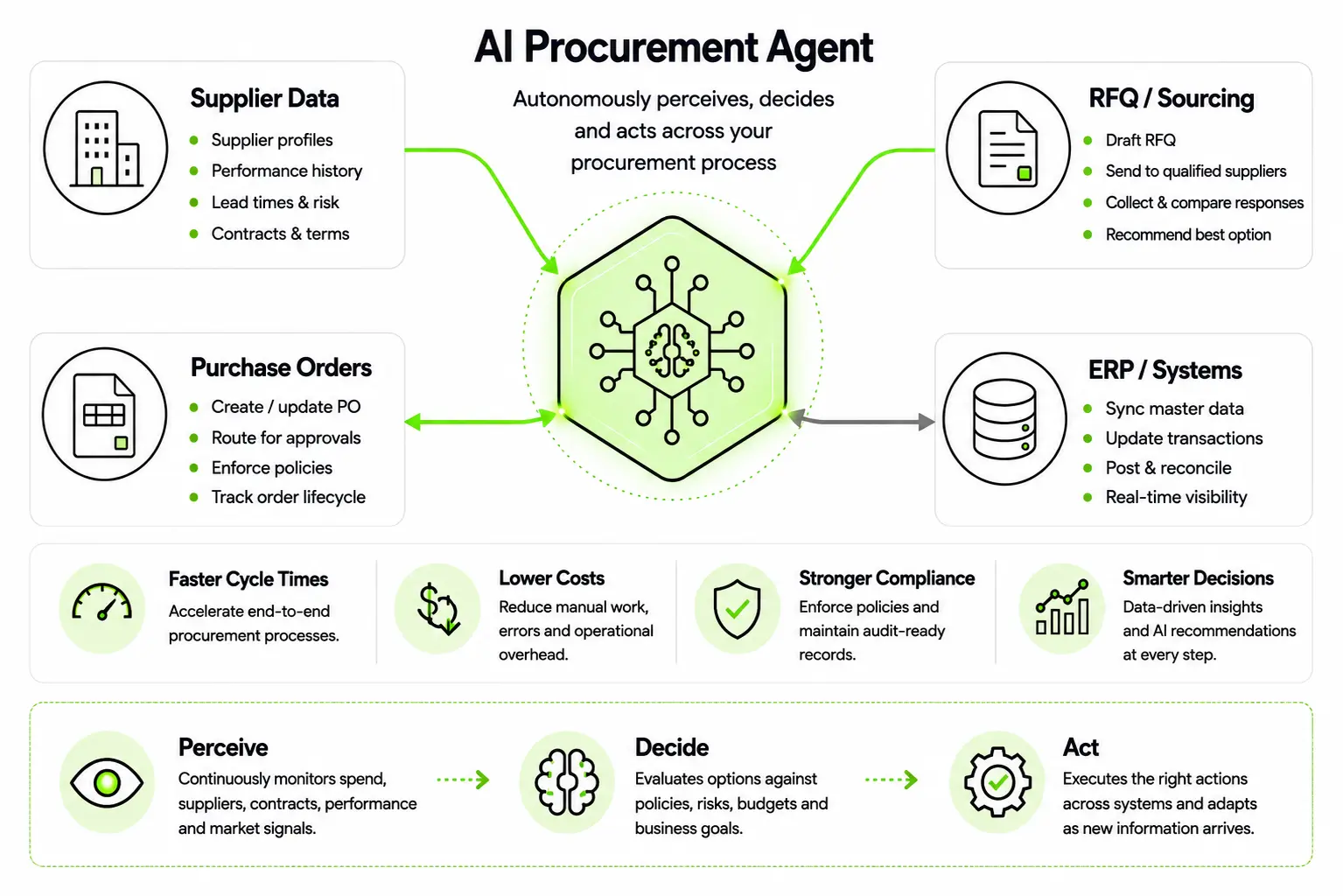
Agentic AI works differently. Rather than following a fixed script, an agentic system can interpret a goal, evaluate the situation it is looking at, and choose an appropriate next step, all within guardrails the organization defines. It does not need to be re prompted at every stage. Give it an objective, such as sourcing a replacement supplier when a primary vendor's lead time slips, and it can pull relevant spend and supplier data, draft an RFQ, send it to qualified vendors, compare the responses, and surface a recommendation, adapting as new information comes in along the way.
This is the practical distinction between automation and agentic AI in procurement: automation follows rules, agentic AI pursues outcomes. That difference is why procurement is increasingly described as one of the business functions best suited to agentic AI. Procurement automation and AI procurement software already produce clean, structured data (purchase orders, invoices, contracts, supplier records), and procurement decisions tend to be judgment intensive but bounded by clear policies, which is exactly the kind of environment agentic systems are designed to operate in. A helpful way to picture it: a rules based bot is a vending machine, it dispenses exactly what the rule says and jams the moment something does not fit. An agentic system is closer to a junior buyer who knows the policy, notices when something is off, and works out a sensible next step on their own.
How agentic AI actually works, perceive, decide, act
It helps to break agentic AI in procurement down into a simple loop: perceive, decide, act.
In the perceive stage, the system continuously monitors relevant data, spend patterns, supplier performance, contract terms, market pricing, rather than waiting for someone to ask it a question. In the decide stage, it evaluates that information against the organization's policies and objectives: is this spend within budget, is this supplier still meeting risk thresholds, does this contract need renegotiating before renewal. In the act stage, it executes, or recommends and executes once approved, whether that means drafting a purchase order, sending an RFQ, flagging a supplier for review, or updating a forecast.
The loop repeats continuously, which is what separates it from a one off automation script. A rules based bot runs once and stops. An agentic system in procurement keeps watching, keeps deciding, and keeps acting as conditions change, all while staying inside the approval boundaries a procurement leader sets.
Where agentic AI is already changing procurement
Agentic AI in procurement is not theoretical anymore. Here is where it is showing up in live deployments right now.
Autonomous RFQ generation and bid comparison. Instead of a buyer manually drafting a request for quote, distributing it to a supplier list, and building a comparison spreadsheet by hand, an agent can generate the RFQ from historical specifications, send it to qualified vendors, normalize the responses into a single comparison view, and flag the best option against price, lead time, and past performance. What used to take a buyer the better part of a day, chasing responses and reformatting them into something comparable, can happen in the background while the buyer works on something that actually needs their judgment.
Continuous spend anomaly detection. Rather than a monthly spend review, an agentic system watches transactions as they happen. When a category approaches its budget threshold or a price spikes unexpectedly, it can surface the anomaly immediately and, in some deployments, automatically pull in alternative supplier options.
Supplier risk monitoring. Agents can continuously scan financial health signals, delivery performance, and even geopolitical or news based risk indicators, flagging supplier instability before it disrupts a supply chain rather than after an order has already failed to arrive.
Contract renewal and negotiation support. Agentic systems can track renewal dates, compare current terms against market benchmarks, draft renegotiation language, and route it for approval, cutting down the number of contracts that quietly auto renew on unfavorable terms simply because no one caught the date in time.
Purchase order creation and three way matching. This is one of the most mature use cases: an agent can generate a PO from an approved requisition, match it automatically against the goods receipt and invoice, and only escalate to a human when something genuinely does not reconcile.
Generative AI vs. agentic AI, clearing up the confusion
Vendors have not made this easy. The words "AI," "automation," and "agent" get used almost interchangeably in procurement marketing, and it is worth being precise about what each one actually does.
Generative AI is good at producing content on request: summarizing a supplier proposal, drafting an RFQ description, or answering a question about a contract clause. It responds to a prompt and stops. It does not maintain memory across steps, and it does not take action inside your systems on its own.
Agentic AI is built to orchestrate. It maintains context across an entire workflow, coordinates actions across multiple systems (your ERP, your sourcing platform, your supplier portal), and keeps working toward a goal without needing a new prompt at every step. In practice, the most effective procurement platforms combine both: generative AI to interpret and draft, agentic AI to plan and execute. Knowing which one a vendor is actually describing will save you from buying a chatbot when what you needed was a workflow engine.
What the numbers say about agentic AI's impact
The gap between agentic AI's potential in procurement and its actual adoption is unusually wide right now. A recent Harvard Business Review analysis found that agentic AI adoption in procurement sits at roughly 9%, compared with over 30% in software development and IT operations, even though procurement's structured, policy bound workflows make it one of the functions best suited to the technology.
Where organizations have adopted it, the results are notable. Recent industry research suggests around 80% of procurement executives now treat AI as a priority investment rather than a nice to have, and early adopters report cutting manual work by close to a third, with cost reductions approaching 45% in some AI enabled workflows. Analysts also expect roughly 40% of enterprise applications to embed AI agents in some form by the end of 2026. None of this means results are guaranteed. It means the organizations that get the fundamentals right, clean data, clear policies, and a realistic rollout plan, are seeing outsized returns compared with those still running procurement the old way.
The real risks and challenges to plan for
None of this works without groundwork. Agentic AI is only as good as the data it perceives, and most procurement organizations are sitting on years of inconsistent supplier records, duplicate vendor entries, and spend data spread across disconnected systems. Feeding an agent bad data does not just produce bad recommendations, it produces bad actions, taken autonomously.
Governance is the second challenge. An agentic system needs clearly defined boundaries: what it can decide on its own, what requires human sign off, and what it is never allowed to touch, such as new supplier onboarding above a certain spend level or any contract change involving legal liability. Skipping this step is how a helpful agent turns into a liability.
Change management matters just as much as the technology. Procurement teams have been burned before by tools that promised autonomy and delivered more dashboards. Trust is earned incrementally: start with agents that recommend and let a human approve, then expand autonomy only in the areas where the agent has proven reliable.
Finally, be skeptical of the word "agentic" itself. A useful test borrowed from procurement technology analysts: if a system waits for you to review a recommendation before anything happens, it is analytics, not an agent. Plenty of vendors are relabeling existing automation as agentic AI without changing what the software actually does.
A practical roadmap for getting started
You do not need to overhaul your entire procurement stack to start using agentic AI. A staged approach works better and builds trust along the way.
Start by identifying one high volume, well defined process, purchase order matching or RFQ generation are common starting points, since they are structured enough for an agent to handle reliably. Next, get your data foundation in order: consolidate supplier records, clean up duplicate entries, and make sure spend data flows into one place the agent can actually see. From there, define your guardrails before you define your use case: decide explicitly what the system can act on autonomously and what always needs a human in the loop. Run it in a recommend only mode first, and only expand its autonomy once it has demonstrated it makes the calls you would have made yourself. Bring finance and IT into that conversation early too, since they will care about audit trails and system access long before procurement gets to scale the rollout. Finally, treat this as an ongoing capability rather than a one time project. The organizations seeing the strongest returns are the ones continuously expanding what their agents are trusted to handle, not the ones that deployed once and stopped.
Where Gezora fits in
Gezora's Procurement Automation platform is built for exactly this shift, connecting sourcing, purchase orders, and supplier data in one place so that automation, and eventually agentic AI, has clean, reliable information to work from. Rather than bolting AI features onto a legacy procurement tool, the goal is a platform where automation, analytics, and increasingly autonomous workflows are part of the same system from the start. If you are trying to figure out where your own procurement operation sits on that path, it is worth a closer look.
The bottom line
Procurement automation got teams out of paperwork. Agentic AI is what gets them out of babysitting the automation itself. The technology is real, the early results are strong, and the gap between what is possible and what most procurement teams have actually deployed is wide open right now. That gap will not stay open forever. Teams that start building the data foundation and governance model today will be the ones positioned to move fast once agentic AI becomes the default rather than the exception.
Topics
- Agentic AI in procurement
- Procurement automation
- RFQ automation
- Supplier risk monitoring
- Purchase order automation
- AI agent governance
- Enterprise AI adoption
Frequently asked questions

Get started
Stop paying people to do what an agent can
Tell us what you want to automate. We will map the workflow, deploy the right agents, and train your team to run them.
- Every agent is trained on your own workflows, never a generic template
- Most deployments are live within two to four weeks
- SOC 2 compliant, with a complete audit trail on every deployment